Showing posts with label wood. Show all posts

Friday, August 28, 2009

Dear Diary


Marlies Romberg
Top Secret USB Stick
Dear Diary 1.0
porcelian and silicone
wood
Image: mocoloco.com - modern and contemporary design blog

A quickie today that I discovered looking for something else, as usual. Marlies Romberg's goal: "to materialize the ungraspable fast digital world and create an opportunity for nostalgia in this future world."(mocoloco.com)

more images: http://mocoloco.com/archives/011440.php

Thursday, June 25, 2009

Shephard Fairey

Shephard Fairey
OBEY BILLBOARD (CONSUME) on WOOD HPM

image: obeygiant.com

Hello!
So sorry I've been MIA, my excuse is travel and preoccupation. Despite a sprained ankle I managed to get myself to see some art while in Boston this weekend. We visited the ICA Boston. There was a show focused on the work of Shephard Fairey which most of you would recognize from our recent election. "Obama Hope" 2008 (Image: icaboston.org). See about the current controversy and lawsuit over the Hope image I wasn't expecting too much from the show, turns out I had no idea of the work that Fairey has produced as well as the gorgeous use of mixed materials as well as large murals. This is the first museum survey of Fairey's work.

Fairey is known for his Obey series. Read the manifesto here: http://obeygiant.com/about
See more work here: http://obeygiant.com/industries

Tuesday, April 14, 2009

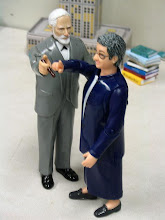
Dada marionette

Freud Analytikus (Freudian Analyst), 1918
Sophie Taeuber (Swiss, 1889–1943)
turned, painted wood, brass ornament, and metal joints


A work from the Dada exhibition at the National Gallery of Art (Washington D.C.) in 2006, the search for this artist sparked by a new book, Dada's Women by Ruth Hemus.

"In 1918 Taeuber received a commission to design the stage sets and marionettes for a production of Carlo Gozzi's play Il re cervo (König Hirsch/King Stag), adapted by Werner Wolff and René Morax. It was the first performance of its kind to integrate Dada and psychoanalysis. The animating conflict of the play was the 1913 controversy between Sigmund Freud and Carl Jung over the character of the libido. Taeuber commented ironically on this antagonism by creating marionettes whose inherent freedom from the constraints of human anatomy and motion allowed them to manifest interior, or psychic, states in their physical forms." (Taeuber bio, nga.gov)

This is not a work that I should be neglecting due to my interests in art and psychoanalysis, but alas, I admit to severe laziness the last few days. I hope to return to it. Hope you enjoy the marionette! Follow the link in the work title and you can zoom in on the object as well as spend some time with the world of Dada.
Friday, April 10, 2009

Medieval statuary

Shrine of the Virgin, ca. 1300
German; Made in Rhine Valley
Oak, linen covering, polychromy, gilding, gesso; Overall: 14 1/2 x 13 5/8 x 5 1/8in. (36.8 x 34.6 x 13cm) closed: W. 5in. (12.7cm)
Metropolitan Museum of Art (17.190.185) (Image)

In a search for carved ivory (which will surely be appearing soon in a future post) I came across thia beautiful statuette/altarpiece.

When closed we see the virgin Mary nursing the Christ Child, the child holding a dove (of the Holy Spirit). When opened it turns into an altarpiece. The interior of the 2 side wings of the altarpiece have painted scenes of the nativity.

Thursday, February 26, 2009

Ancestor Poles

Ancestor Poles (Bis)
Asmat people, Omadesep village, Faretsj River, southwest New Guinea, Papua (Irian Jaya) province, Indonesia, mid-20th c
Metropolitan Museum of Art
1979.206.1611
Images: ALH


While attempting to find the Alexander Calder Jewelry show at the Met last weekend, I wandered into the new galleries for Oceanic Art and what a great surprise.
These memorial poles (mbis) are erected to honor the dead and the Asmat believe they house the recent dead's souls and display them in front of the men's house.

They used to go headhunting for an enemy head to place in the lower cavity, hence the bent pose of the figures being associated with the praying mantis (symbol of headhunting - ah, as the ladies love to bite the heads off of their mates!). (Stokstad - Art History 904). The figures are beautiful and fascinating. When I first became interested in art in highschool I randomly decided I was going to study Oceanic art (for no reason other than I liked the term Oceanic I think :) I definitely shifted gears into Modern and Contemporary didn't I?

If you are at the Met in the future I highly recommend checking out the new galleries, the space and art blend beautifully.

Friday, January 16, 2009

Monkey

Sitting Monkey, 2nd-1st centuries
State of Chu, Southern China
Lacquered carved wood
Mingqi (ming-chee, object for burial chamber)
Toledo Museum of Art 2005.49

Animals are fantastically prevalent in art throughout the centuries, from small companions and magical creatures to monkeys! Monkeys are so common in the TMA collection that there has been mention of having show just to showcase them. I discovered this wonderful little gem on my first jaunt into the Asian Galleries (and yes I should be reprimanded for not visiting them sooner, but hey my MA is in Modern and Contemporary Art! ;).

I think it is fairly cool that many of the objects I am attracted to, I later realize are highlights of the collection, which is also good because I need to build up that knowledge to be the best art librarian I can be of course.

This little monkey is particularly rare due to its age and being made out of wood, a material we would think would have long since ceased to exist after 2000 years in the form of this burial object. These figures were coated in a thin lacquer that proved resistant to insects and water. Funerary wares were so important during the Tang Dynasty that there was an government agency responsible for overseeing their manufacture. (nga.gov.au)

Yay for art, creativity and learning. A google search for mingqi brought up as a first hit an art project for students to create their own mingqi out of clay. The education programing that museums provide is fantastic, if you have a great kid in your life I highly recommend checking out what your local art center or museum offers for kids, from hour long drop in projects just for kids to recurring courses and activities for kids and adults to do together.

Monday, January 12, 2009

Bodhisattva

Guanyin (bodhisattva)
Ming Dynasty, 1368-1644
painted wood

China, Sinxi Province

Toledo Museum of Art
image courtesy of ALH (click on the title for the museum's professional photo :)


This week, I am going to focus on art in the collection of the Toledo Museum of Art. I spent Sunday afternoon wandering through most of the galleries, visiting favorite works and venturing into galleries I haven't given much time to in the past. I discovered some wonderful new works.

Today, we venture to China. It's rare that I come up with pre-20th c. non-western art, and that is very much a significant gap in my knowledge and education (mostly my fault). I have a tendency to skip over these galleries but happily spent some time in them today.
Guanyin is the bodhisattva (enlightened being who refrains from entering nirvana to help other achieve enlightenment) most associated with compassion and is usually represented as a female. In this sculpture, Guanyin is represented as the form of an androgynous prince. "One of the most popular Chinese deities, Guanyin comforts the souls of the dead and acts as mediator for the wishes of the living. Carved from interlocking blocks of wood and once brightly painted, this sculpture originally sat on an artificial rocky ledge as part of a visually rich temple setting in north China."(TMA caption) Seeing these wood sculptures in person is wonderful, as you can often see remnants of paint that have survived the years. I enjoy envisioning the sculpture in its original polychromed (multi-colored) form.

A new resource I came across while researching this entry, the Rijksmuseum Amsterdam has a pretty good art encyclopedia on its museum website, it is in English and has audio for the entries. The entries surely stem from their collections but they are decently broad so it has a lot to offer.